
Musings, meetings and more…
Newsletter Editor Alastair Duncan writes:
Dear members
Feeling cold? Forget the winter chills, the ‘new’ water authority and its bills, the disappearance of the Golden Mile, the reshuffling of the electoral boundaries for the forthcoming general election, the gutting of the public services and the cancelling of pay equity. These ,and more, are surely enough to make most of us hot under the collar and generate our own heat.
For me, the latest ‘hot’ topic is the ongoing debate about National Super. As a certain Mr Peters strives to claim it was all his baby, his coalition colleagues, Messrs Luxon and Seymour, are giving notice about an increase in the qualifying age. Labour says it will remain sacrosanct at 65 but if they want our vote we’d better see some policy while Greens argue for a comprehensive range of support around housing and income across the board.
With all that going on, I couldn’t help but wonder if ‘Opportunity” and it’s guaranteed minimum income proposal might at last, open the way for a real discussion about how on earth anyone who relies primarily, or even exclusively, on National Super could be expected to live, let alone survive on weekly payment of just $555.15 for a single living alone.
During what may yet be the last ever census, I took on a part time job calling on properties where the resident had yet to return their census papers. This took me across Wellington from social housing units in Miramar to grand old houses in Karori. And it was in Karori where I found my perceptions of that suburb challenged. All too often I was in properties where the weeds had swallowed the garden, the gutters were growing forest and the paint was flaking off the front door. And all too often when the owner occupier answered the door she, they were nearly always women, she revealed an interior that was shabby and cold. On paper she might have been a millionaire. On paper. But that’s not how they lived.
At the other end of the property spectrum, I found flats in the depths of the Aro valley with cardboard where there should have been glass and mould over the walls. Consider my old friend “John”. He lives alone and was made redundant before he turned 65 and living in an apartment that proved to be a leaky building. Facing a repair bill, he couldn’t afford; he sold up and moved into a series of rental units. A decade on he has around $20 k in the bank so he doesn’t qualify for housing assistance and his rent is $500 a week. Like many of us, John struggles with change and coupled with his constant fear of being evicted (now that ‘no fault’ eviction is the law) he is frightened to challenge the landlord.
For John and the dowagers of Karori a lifetime of service and tax paid surely means they deserve better. Yes, let’s debate super. But let’s do so in a way that makes it sufficient to live rather than merely survive.
What’s on top?
In this issue Grey Power member Peter Hooper takes a look at what NZ Firsts’ move to limit voting rights for non-citizens means, Acting Wellington Association secretary David Cuthbert draws on the AGM’s guest speaker Geoff Bertram and his critique of the electricity industry price gouging. Association President Colleen Singleton reports on the recent Branch AGM and state of Grey Power outside of Wellington.
Colleen stood down from the Grey Power Federation Board at this year’s Federation AGM having worked diligently to encourage the Federation to live up to its espoused activist origins. The good news is her re-election to the Wellington Central Committee means she can spend even more time on local issues!
PS Treasurer Bruce McLachlan reports we are financially secure with about $20,000 on term deposits.
Wellington Central Grey Power Association Inc Annual General Meeting
The Annual General Meeting (AGM) was held on 22 June at the Quaker Meeting House and attended by 24 people. Apologies were received from 6 members. I thank those attending, ensuring a quorum, and having the opportunity to hear Geoff Bertram talk about his alternative solution to increasingly high electricity costs.
The Committee’s annual report had been circulated to members and was adopted by the meeting. It is available on the Association’s website https://greypowerwellington.org.nz/. The Association is in good heart financially and the meeting adopted the Acting Treasurer’s Statement of Accounts. Compared with other Associations, Wellington Central has always been able to reimburse travel to Zone meetings in Palmerston North and Federation AGMs, which have been held in Wellington over the past few years. Next year the AGM will be held in Invercargill. During the year the Committee made a $500 donation to Age Concern and a $100 donation to a Federation appeal. We thank our forebears for leaving us this inheritance. Your Committee welcomes suggestions for donations to organisations that will assist older people.
The following members were elected to the Committee.
- President, Colleen Singleton
- Vice-President, David Cuthbert
- Acting Treasurer, Bruce McLachlan
- Membership Officer, Owen Watson
- Committee member, Peter Hooper.
It was resolved that the Committee have power to co-opt Committee members. The Committee has co-opted volunteers Alan Wright and Stephen Cooke as the Catering sub-committee. No doubt they will extend catering to welcoming, moving chairs and whatever else needs to be done. Thank you for your assistance with these tasks.
While we have put out a call for members to volunteer for the Committee, during general business one member reminded us that we might have to shoulder tap.
Power to the people?
Earlier this month economist Geoff Bertram gave a presentation to U3A about the formation of the Coalition for Open Government in the 1980s whose activism and creativity ultimately led to the Official Information Act. Back then electricity generation and supply was a critical part of the public service. These days it’s corporatised, privatised and a licence to print money – for the owners.
At the recent Wellington Central AGM , Geoff continued his decades of good work giving an excellent presentation on the state of the electricity industry not with slides but some sketches to illustrate some key points
He outlined the development of the national electricity system via the NZ Electricity Department and the construction of hydro dams and other generating plants in the period from the 1930s to the 1980s, then corporatisation and the forming of the Electricity Corporation (ECNZ). Then followed the move in the 1990s to privatisation of the system.
He continued with the sorry tale of the four big generating companies moving to vertically control the industry through the ownership of the supply companies and how through revaluations and other means the companies have increased the profit they extract from the system.
And he outlined the grim news that, despite the move to solar and wind generation, the price charged for electricity will be determined by the most expensive generation plant. He, of course, indicated that it required political change to alter that situation and noted that this was not likely under the current political makeup. His solution was to move to a system of public control along the lines suggested by the Greens’ recent proposal.
Geoff closed by generously responding to numerous questions. Questions that should be on the agenda for this year’s general election.
Grey Power Federation AGM and Zone 4 (lower North Island)
The Grey Power Federation AGM was also held in June. With the change from seven elected Zone representatives to five Board members elected at large, the new Board is swinging into action. Zone 4 is well represented with Lew Findlay, Treasurer and Nerrily Frith from Wanganui and Carolyn Bates from Rangitikei Associations elected. Roberta Budvietas from Hastings and District Association has been elected the Zone 4 Facilitator. Roberta will give a new lease of life to Zone 4 activities. The role of Facilitator has been extended to being more active in supporting Associations, especially those at risk of closing as insufficient members volunteer to form a committee.
Digital Delegate Programme
Federation Coordinator Johnathan Dietz ran a trial for a digital delegate programme whereby digital delegates could participate and vote live from their home. The programme proved popular and is likely to be expanded next year with increased interactivity between digital delegates and in-person delegates. The first digital delegates for the AGM were from Kaipara, Buller, Thames, Whangarei, Mercury Bay, Te Awamutu and North Canterbury Associations.
Election of President and Board Members
David Marshall was elected as President and Lew Findlay was re-elected as Treasurer, with Carolyn Bates, Nerrily Frith, Terry King, Bill Obers and Graeme Peters elected as At-Large Board Members. Graeme Peters was subsequently appointed as interim Vice President to fill the vacant position.
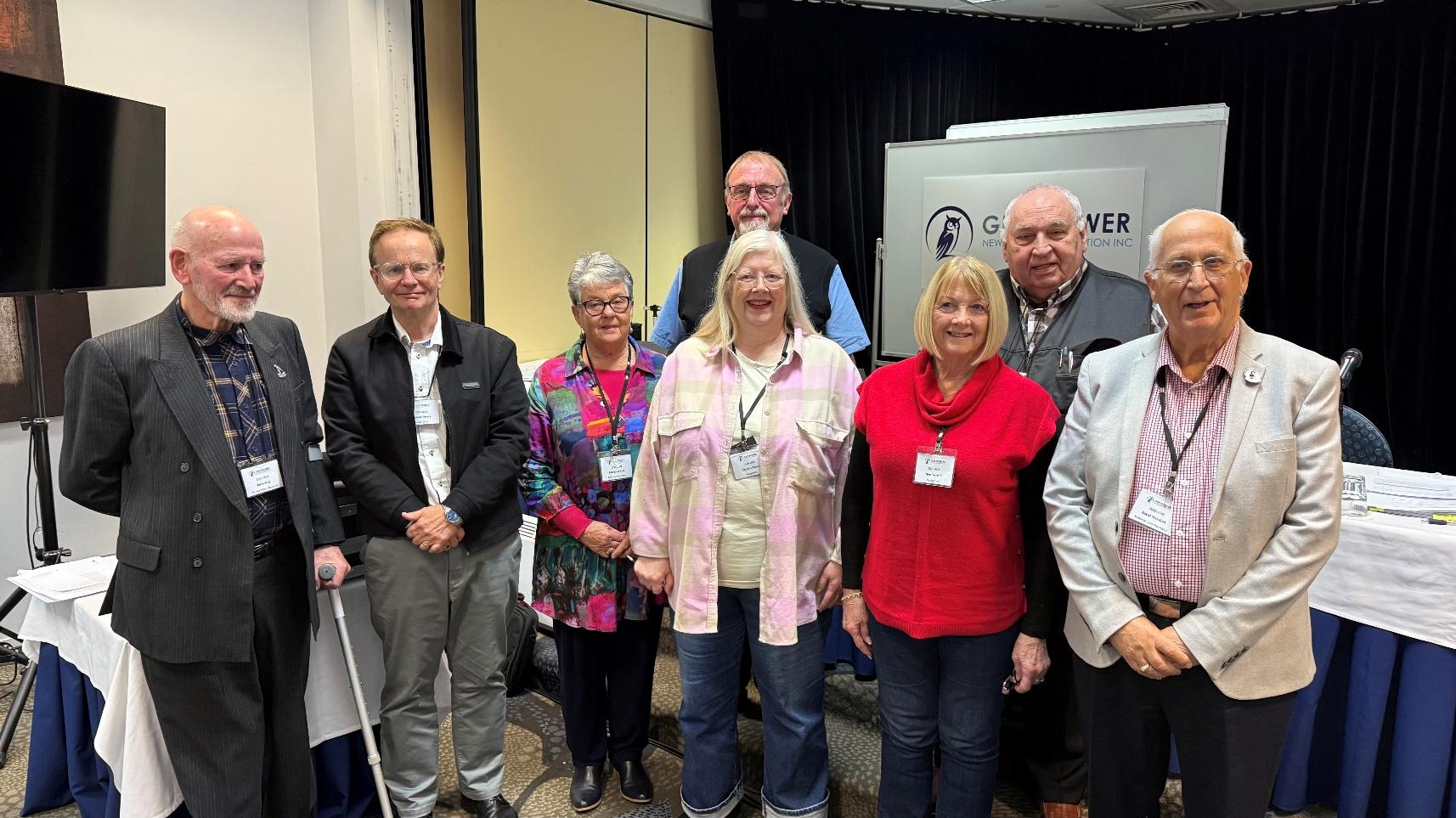
From left to right: Terry King, Graeme Peters, Margaret Sole, Bill Obers, Carolyn Bates, Nerrily Frith, Lew Findlay, and David Marshall
Workshops
Two workshops with delegate participation were useful.
The Federation Coordinator led the workshop on What the Federation Can Do for You
Delegates focussed on challenges in attracting and retaining members, sharing successful strategies and identifying Association support the Federation could deliver.
National Treasurer Lew Findlay led a workshop on Associations working together. Delegates discussed ways Associations can support each other through joint meetings, sharing resources, and coordinated training, with an emphasis on the role of Zone Facilitators.
Treasurer Lew explained the new Service Performance Reporting (SSP) for audit purposes. Each Association to submit monthly reports documenting activities such as meetings, public speaking, advocacy, and media engagement to support Federation advocacy and compliance with government regulations.
Guest speakers
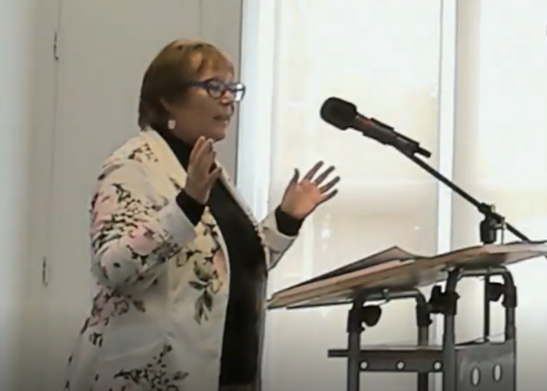 Tracey Martin, CEO of Aged Care Association, spoke about the state of aged residential care outlining sector challenges, trends, funding issues, and advocacy strategies. She urged Grey Power to use its influence to engage with MPs and advocate for improved aged care access, emphasizing the importance of coordinated messaging during the election period.
Pulse Energy CEO Sharnie Warren gave an update on the partnership between Grey Power and Grey Power Electricity, including customer service improvements such as Lisa, the dedicated Grey Power Electricity account manager, new product offerings such as the Power Lunch & Power Shift plans, plus community initiatives and grants that GPE funds.
2027 Annual General Meeting
Delegates approved the proposition that the next 2027 AGM be held at the Ascot Park Hotel in Invercargill.
Acknowledging retiring board members
The AGM closed with thanks to retired President Gayle Chambers and particularly for her advocacy and visits to Associations. Also acknowledged were retiring Board members Colleen Singleton and Bill Rayner. The office staff were thanked for their ongoing service and their assistance during the AGM. Special mention was made of Grey Power Kapiti Coast’s President Roger Booth’s leadership and 20 years’ service, including time on the Federation Board.
Editors footnote: Nationally Grey Power membership has fallen from 60,000 to around 30.000 in the last decade. At last year’s Federation Annual Meeting the Wellington Central Association noted that there had been a similar decline in the amount of campaigning and lobbying done by Federation. Wellington President Colleen Singleton reminded the audience that Grey Power is about more than shopping discounts. With a new board in place we look forward to the Federation being the campaign body it once was.
Launch of Doors to Dignity at Parliament
The Christchurch Methodist Mission has asked the Government to fund more social and affordable housing for older people. The Mission has seen an alarming rise in the number of older people in housing distress, including some who are at real risk of homelessness and believes it is vital to encourage MPs from all political parties to commit to finding long-term solutions to this crisis. Grey Power Federation supports this mission. More information available at https://www.doorstodignity.nz/
My friend lives here, pays taxes and contributes to his community. Should he lose the right to vote?
NZ First wants to remove voting from those working in NZ who have permanent residency visas, but not citizenship. Peter Hooper is concerned about the implications.
To place a focus for this piece of writing it is helpful to argue that the NZ First Party’s idea is not something which would improve New Zealand 2026; quite the opposite, it would undermine a significant part of what New Zealand is currently. For almost my entire life a migrant with a permanent residency visa has been able to vote in NZ. (Legislation set up in 1975 provided this possibility for migrants who meet specific requirements.) That period of 51 years is significant, and raises the question for Winston Peters and NZ First, why now?
A person born outside New Zealand who comes here as a migrant can come here temporarily, perhaps to study, perhaps for work experience, with no intention to stay, and this is straightforward and does not include the right to vote in elections both nationally and locally.
A different position is where a person comes from outside New Zealand, stays here for a period of time and develops a commitment to the country where they wish to stay. They are required to meet certain benchmark qualities in what they do, what they bring to the country, and how they contribute in order to entitle them to gain what is called a permanent residency visa. This second style or way of being a migrant in New Zealand does include the ability to vote.
Later they can apply for citizenship should they wish to and that changes their political involvement profile quite a bit, they can apply to become one of our MPs.
The person with a permanent residency visa does have a more substantial profile than a tourist on a brief holiday in New Zealand. The benefit this person brings to the country comes via what they do, what they contribute, and how they see themselves as an individual making a contribution to New Zealand in a way that suggests stability and a positive understanding of themselves inside our borders.
Regarding their country of origin, there may be different conditions regarding their freedom. My intention here is to demonstrate a person can be influenced by personal and family issues, as well as links to constraints set by their country of origin. They may have parents or children in their country of origin who shape choices. Those links may well limit what the person believes they are free to choose; however, those limits may be embraced willingly. With commitment comes responsibility. To remain linked to one’s place of birth can be limiting and fully understandable. This dynamic may shape whether a person makes the decision to seek citizenship in New Zealand,
A different dynamic may be politically contextual. Some countries, for example, don’t allow a person to have dual citizenship of two countries, one being their country of origin and the second one being a country such as New Zealand,
The “why now” of Winston’s announcement may be a populist move to gain some local support in the up-coming NZ general election. It might be labelled a dog-whistling move, the subtext being anti-immigrant sentiment.
If this is a dynamic, and this point has been stated by others such as Mike Grimshaw, Associate Professor of Sociology at the University of Canterbury. One notes another NZ academic has expressed his interest, the NZ historian Paul Moon, an academic at Auckland’s University of Technology. The why now question may be more meaningful to explore than the argument this idea by Winston has any objective merit.
A reader would be an odd person if they genuinely had no links with those born outside New Zealand. It is interesting how this statement can be read. It could be read as an acknowledgement that the person who was so kind to you when you visited the emergency department of your local hospital and provided care, or the person at the local Pak’nSave served you as a cash teller when you paid for your weekly groceries, or maybe you were sufficiently self-aware that those farm produce items in your bag were possibly harvested from the earth by a migrant worker you may never meet. All these people are worth our respect and gratitude.
A second reading is even more significant, you may know a person, they have not been born here, and you are incredibly grateful because they are wonderful people, they like you and you like them. You believe you benefit, along with others because of their commitment to New Zealand and what they bring to this place.
Winston Peters and NZ Firsts are sending a negative message to migrants who throughout my life I have come to see as valued persons that go beyond being a passing tourist.
As the founding fathers of the USA stated. “No taxation without representation!”