
| Wellington Central Grey Power Association Incorporated Annual General Meeting
Notice is given that the Wellington Central Grey Power Associated Incorporated Annual General Meeting will be held on Monday 22 June, at the Quaker Meeting House, 7 Moncrieff Street, Mt Victoria. The meeting will start promptly at 12.30. The meeting will be addressed by Geoff Bertram. Geoff is an economist and has had a long interest in the role of government in a market economy. Afternoon tea will be served. Colleen Singleton |
Message from President Colleen

Your Committee has had some interesting items to consider of late – some of which may not come to your immediate attention. The purpose of Grey Power is advocacy and we are back in our stride with that. I‘ll touch on them briefly as there may be more detail in the newsletter.
We completed a Wellington City Council survey on four key proposals: short-term accommodation rating (e.g. AirBnB, Bookabach); bike network; contaminated waste fees; cremation fees.
The public meeting with Mayor Little was well attended. The Mayor did not use his prepared speech, rather talking about issues that relate to the functioning of the city. He was generous with his time and the questions covered a wide range of the Council’s governance and operational activities.
Every now and then something comes out of the blue – this week it was the Labour Leader’s statement that he was open to a conversation about means-testing superannuation. The proposed surcharge was the genesis of Grey Power. Your committee has been active in letting the media know Grey Power’s viewpoint. Thank you to those members who have voiced a different opinion – you views will be passed on to the Federation Board.
On 28 May the 16 Associations in Zone 4 will elect the Zone Facilitator for the next 2 years. In mid-June the new Board members and the President and Treasurer will be elected at the Federation Annual General Meeting.
Colleen Singleton
President
Little draws a lot
 It was almost standing room only in April when Mayor Andrew Little came to a public meeting hosted by Wellington GreyPower on April 10th.
Welcoming the Mayor, Wellington GP President Colleen Singleton reminded the Mayor, and the audience that Grey Power is ‘all about advocacy’ and in a wide-ranging presentation Mayor Litte certainly understood his audience was there to both listen and to ask their questions.
As he had in the run up to the local body elections, Little stressed his past roles as union secretary, Cabinet Minister and lawyer as assisting him to prepare for the role and, having decisively won the popular vote the need to use the Mayoral office to help councillors work effectively, both with each other and with council officers.
Conscious of the focus on Council spending, Little cited a range of examples of where added costs on large projects had been either ignored or signed off without sufficient scrutiny, a practice he committed to end.
In a wide-ranging discussion kicked off with criticism of cycle lanes, e-scooters and parking challenges, Little sympathised while pointing out that for the likes of e-scooter regulation that was a matter still awaiting direction from central government. When asked by one audience member why she could no longer park outside her favourite shop on Lambton Quay, Little said he wasn’t sure any city offered such guarantees.
With recent publicity around a projected $6,000 per household water bill, Little won credits for expressing his concern that the setting up of the new greater Wellington Water entity Tiaki Wai Metro Water had effectively transferred a Wellington (and Porirua and Hutt) asset to an unelected body to which the three Mayors could make suggestions but not directions.
Little seems sincere in his wish to establish a working relationship with the current Coalition Government. That is a big call. Before the election Nationals Minister Simeon Brown threatened to put in a Commission to oversee the previous Council. Since then, the Coalition Government has laid off thousands of Wellington public servants and ratepayers. Given the voting pattern of Wellingtonians, with two Green and one Labour MP, it remains to be seen whether Little can use his office to influence the tail end of the present coalition.
Footnote: It was the first time in four years a Wellington Mayor had met with Grey Power, after Little’s predecessor Tory Whanau repeatedly declined to do so.
Aged care. All about us but without us!
As the current publicity about the challenge seniors and families face recovering their investment in retirement village apartments illustrates, the aged care industry is big business, increasingly dominated by corporate operators.
The ‘care’ side of the residential aged care industry is big business reliant on public funding. Before Christmas 2025, the Government announced a new body set up to advise on the funding model needed to support aged care services. Titled ‘Aged Care Ministerial Advisory Group’ the objects include “sustainable aged care services across the country and ensuring care provision sufficient to meet varying levels of care, service delivery and ‘sufficient’ workforce.”
Positively, the terms of reference acknowledge the existence of past reviews, and outdated funding models that do not support providers to sustain or invest in new services. But there the positivity may end!
While feedback referenced by some as being ‘cross party’ the members, headed by former Labour Leader David Cunliffe, are paid $800 a day for their input. The Advisory Group’s Terms of Reference state they will provide a draft report for feedback by 17 April 2026 to the Minister of Health and the Associate Minister of Health with responsibility for Aged Care and their final report with recommendations by 31 May.
When the Government first signalled setting up the group, Grey Power President Gayle Chambers asked Minister Casey Costello whether Grey Power could be included. The Minister said no. Gayle says she is now watching carefully to see what results.
Unsurprisingly, the Aged Care Association, the national voice for aged care providers welcomed the formation of the group. But there remain important questions around the group’s make up.
While Grey Power was shut out, the group’s membership is drawn from businesses and individuals who, directly or indirectly, already have an interest financially in the current care and funding model. They include senior executives from corporate providers Radius and Oceania, both listed on the stock exchange. Both, like all other providers, are also direct beneficiaries of the current funding model that sees the wages for carers and nurses almost exclusively funded by taxpayer dollars. Now it appears they will be writing the rules about their own funding!
For years successive Grey Power leaders have questioned successive governments that have focussed on reports rather than action. So, Wellington Grey Power was keen to know more.
We asked the Ministry of Health what criteria had been used to establish the group. Who was and was not considered. What the budget is (members receive $800 a day and the Chair $1,265) and what was the preliminary advice from the Ministry on the issue.
We are still awaiting a response.
Though the terms of reference appear hopeful they ignore the elephant in the room. Last year’s bomb shell overnight cancelling pay equity claims for tens of thousands of nurses and carers rocked the sector. Pay equity is likely to be one of the key influences in the forthcoming general election so its notable that the advisory group terms of reference specifically exclude the group offering advice on workforce requirements with ‘Budget advice’ specifically excluded.
E tū union delegate Tamara Baddeley is one of thousands of carers who warned that the cancelling would have flow on effects at the workplace. Like Grey Power, unions were also shut out of the process meaning the voice of carers, those closest to residents, was also silenced.
Grey Power Wellington made repeated requests to talk to Group Chair David Cunliffe which were not responded to.
Complaint heading to the UN over aged care pay
It’s nearly 20 years since the then Human Rights Commissioner (HRC) Judy McGregor went undercover as a care worker in a rest home. Her report, Caring Counts, helped lift the lid on the grim face of an industry bedevilled with too few workers caring for too many frail residents.
In May McGregor, now a senior herself, was in the audience when the current HRC commissioner Professor Gail Pacheco announced the Commission, the Pay Equity Coalition of Aotearoa and the NZ Council of Trade Unions has complained to the United Nations about last year’s changes to this country’s pay equity law.
Gail Pacheco said the cancelling of the claims breached a fundamental human right, the more so given New Zealand’s previous role in supporting human rights before the United Nations.
New Zealand is a signatory to the UN Convention on the Elimination of All Forms of Discrimination against women (CEDAW) and the complaint argues the legislation creates systemic barriers to pay equity and limits women’s rights.
Speakers described the previous law as “world leading” and noted that it had been supported by the John Key Government which, in 2017, paid an initial $2 billion to settle the landmark case brought by Wellington carer and Lower Hutt Grey Power member Kristine Bartlett.
Last year, Wellington Grey Power was among the hundreds of individuals and organisations who recorded their opposition to the changes before the Peoples Select Committee, a cross-party body of former women MPs from all sides of the political divide. This followed the Coalition Government taking urgency to cancel 33 existing pay equity cases, impacting 180,000 wage earners, including aged care staff.
Prepared in secrecy, the changes were rushed through Parliament in two days with no opportunity for public input. At the time Finance Minister claimed the estimated cost of the as yet to be finalised claims was $5 billion and unaffordable while ACT party MP Brooke Van Velden said her actions had “saved the budget” ** .
That prompted a petition gathering 96 thousand signatures in a matter of weeks and nationwide protests.
Aged care was just one of many female-dominated occupational groups affected by the change along with early childhood teachers, librarians and teacher aides.
Judy McGregor said NZ was now a “pariah” and the law change had enormous ‘reputational impact’ on this country. Every woman and their family’s needs to voting on pay equity this election.
 |
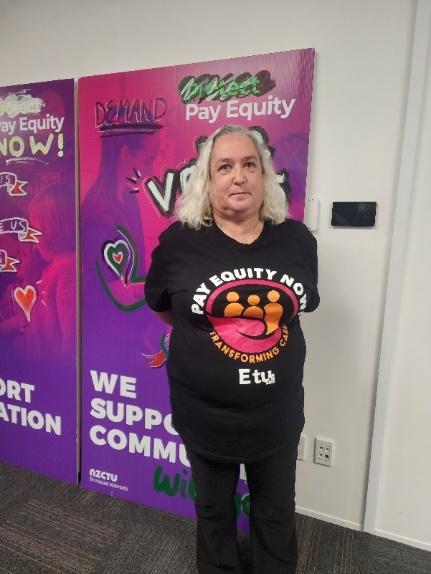 |
| Kristine Bartlett and Colleen Singleton at the May meeting. | E tū union delegate Tamara Baddeley |
**Footnote: Defence force spending increased by $5 billion in the 2025 Budget.
Delivering value – the economic impact of social housing
Committee member Peter Hooper lives in council housing and offers this observation:
I attended a meeting at Parliament about a topic that is topical as we approach the general election; housing where the tenants are as much members of a social cohort as individuals resiling with modern life. Social housing and what it involves is central to the discussion. As readers know, an increasing portion of this cohort are seniors. Us!
Attend any discussion of where New Zealand is going in 2026 and the issue of cost of living is at the forefront. The question is: can we afford it, and who pays? The smart approach is not simply to discuss numbers; the radical question runs along the lines ‘what do we think we are trying to do when that cost is being calculated’.
Social housing is not simply a cost our society chooses to fund.The key question is ‘what are we doing when we set up a structured environment, such as a housing site, and what is its purpose and relationship to wider society, where housing may take on a less structured design but be no less central to what we want to do as a society’.
Research shows that a person seeking to rent may well view social housing as having advantages over renting in the private sector. This may involve a belief in social connection with others, access to support and an opportunity to be a part of something beyond being an anonymous tenant in a suburb. Social housing is more about households and wellbeing than cost. A stereotype that invites stigma is the one that views a senior living in social housing as sitting in a space with one’s hand out, rather than an older person building a life where one has things to offer others.
The Community Housing Provider, Te Toi Mahana, is promoting the view that social housing delivers value and they seem to be challenging this stigma with updated information. What is it we are doing when we think of and discuss social housing?
Any social project, if we want to carry out an analysis, requires that we ask what is the impact on those central to what is being setup? Are they part of the project’s design; are we asking them to let us know what happens for them as the project unfolds; where does this link back to wider society and culture. It isn’t about an individual seated in front of a television with their hand out; it is an inter-connected life, a person who is part of meaningful connections with others where we all gain from what is being lived.